


Why It Matters
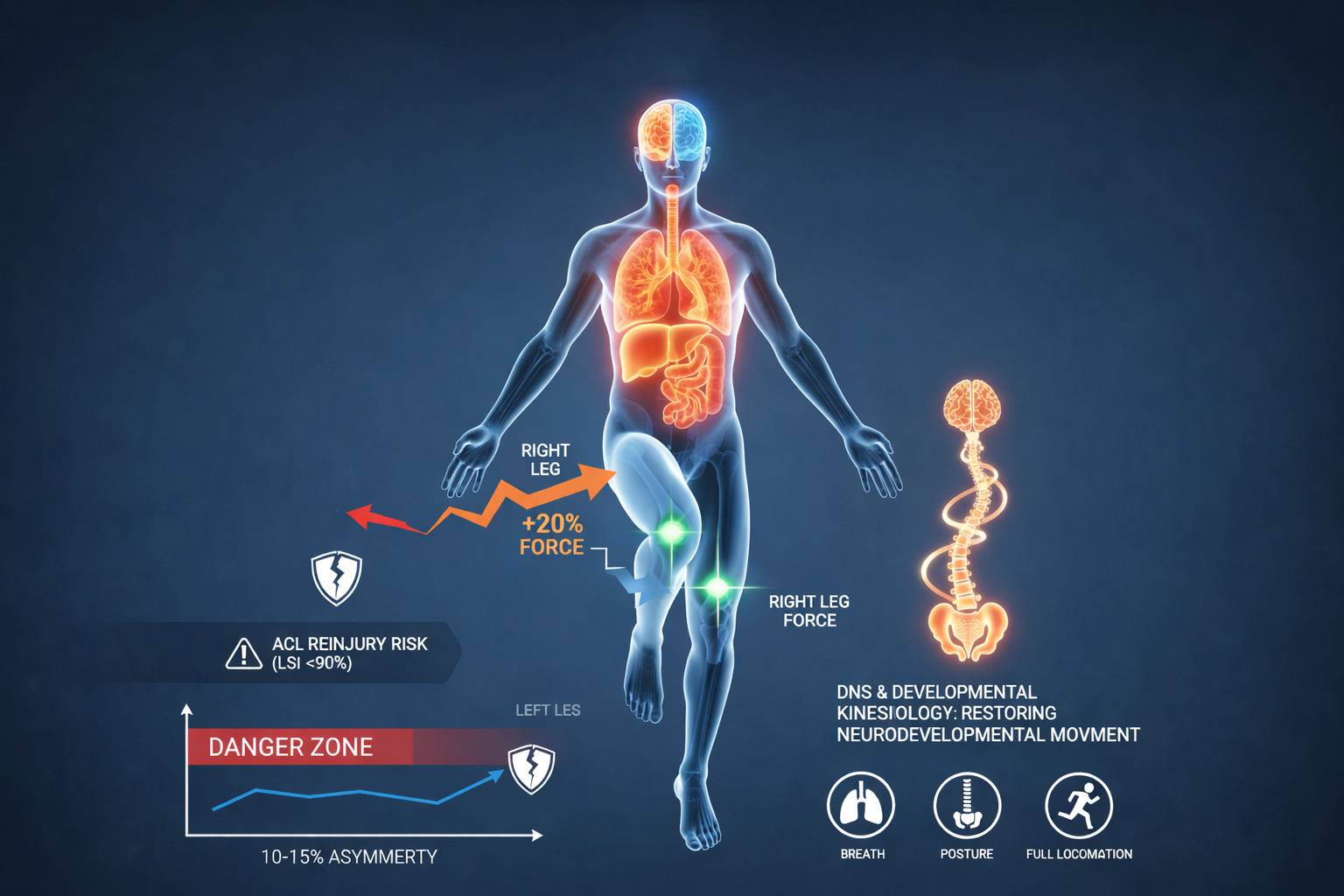
Asymmetry is not a flaw—it's a feature of human anatomy. We have three lung lobes on the right and two on the left; the liver dominates the right side; and the brain exhibits hemispheric lateralization. But when functional asymmetry—meaning how well your limbs and stabilizers perform together—exceeds 10–15%, research shows a dramatic spike in injury risk.
In real-world terms:
-
If your right leg produces 20% more force than your left during a jump, your joints aren’t just inefficient—they’re vulnerable.
-
Athletes with <90% LSI post-ACL reconstruction are up to 4x more likely to reinjure.
-
FMS (Functional Movement System) screens used by the military show that even non-strength-based asymmetries significantly raise injury odds.
But here’s where DNS and developmental kinesiology elevate traditional training models: rather than isolating a muscle or joint, we restore the entire chain of neurodevelopmental movement, starting from breath and posture, and rebuilding up to full locomotion. This method doesn't simply compensate for asymmetry—it resets the nervous system to function in a more balanced, reflexively controlled way.
Step-by-Step Expectations
Assessment for Asymmetry
-
Tools: FMS screens, Y-Balance Test, single-leg hop tests, and segmental motor control evaluations.
-
Focus: Identify discrepancies in range of motion, force output, joint loading, and movement control.
Movement Pattern Reconstruction
-
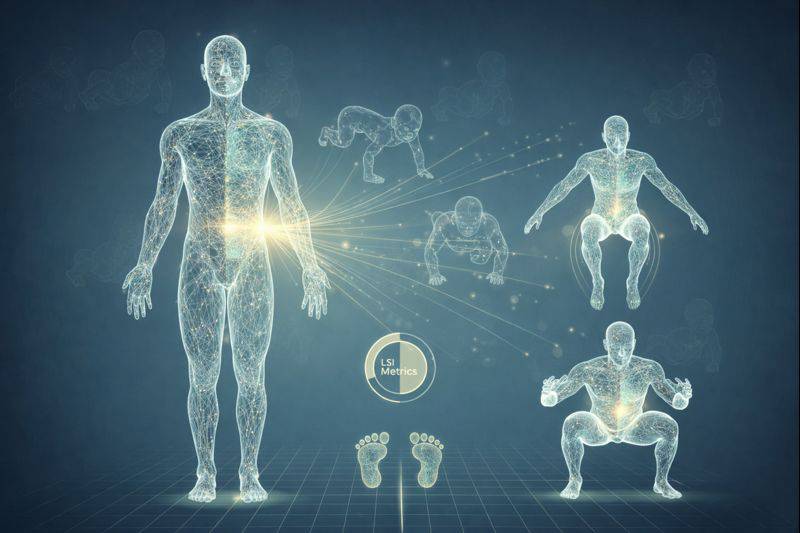
Using DNS and ontogenesis (the developmental timeline from birth to upright walking), we retrace the motor programs embedded in early life.
-
Exercises include 3-month supine positioning, 4.5-month prone-on-elbows, and 7–10 month crawling/sitting postures that teach the body to stabilize centrally before moving peripherally.
Neuromotor Re-education
-
Breathing becomes the foundation. Diaphragmatic activation regulates intra-abdominal pressure (IAP), forming a stable "anchor" from which movement originates.
-
This coordination of breath + core + spine is not voluntary—it’s reflexively driven when the body is placed in DNS positions. That’s the true power of developmental kinesiology.
Symmetry-Based Progression
-
Once reflexive control is regained, we begin to load movement symmetrically, retraining both limbs to coordinate, decelerate, and transfer force evenly.
-
LSI metrics are tracked using single-leg tasks, jump tests, and strength benchmarks to ensure objective symmetry before progressing to speed or intensity.
Continual Reassessment and Pattern Reinforcement
-
DNS-based positions are revisited weekly as part of training hygiene.
-
Postural integrity, breathing efficiency, and contralateral control are continually checked—especially under load or fatigue, when compensation patterns re-emerge.
Core Concepts Explained
| Concept | Explanation |
|---|---|
| Limb Symmetry Index (LSI) | Ratio comparing strength or performance (e.g., hop distance, torque) between limbs. Target ≥90%. |
| Ontogenesis | The developmental sequence of human motor control from infant to adult. DNS uses this timeline as a blueprint for motor retraining. |
| Developmental Kinesiology | The study of how posture, movement, and motor control emerge in infants through CNS maturation. Used to inform DNS intervention. |
| Functional Asymmetry | Disparity in limb coordination, force, or movement quality that alters kinetic chain efficiency. |
| Dynamic Neuromuscular Stabilization (DNS) | A rehabilitative and performance system using neurodevelopmental positions and reflexive core activation to restore central stabilization and joint integrity. |
| Cumulative Loading Asymmetry | When minor asymmetries are repeated thousands of times (running, lifting), leading to overuse injuries. |
Preparation: What You Should Know Before Starting
-
Symmetry is dynamic, not static. This means your body can learn to move more symmetrically even if structurally asymmetrical.
-
Your diaphragm is not just for breathing—it's a postural muscle. DNS uses breath mechanics to build trunk stability from the inside out.
-
You don’t need pain to have dysfunction. Asymmetries often precede injury by months or years.
Aftercare: Sustaining Your Symmetry
Corrective interventions are not a one-time fix. Symmetry must be:
-
Maintained through progressive bilateral loading.
-
Integrated into daily tasks and sport-specific drills.
-
Reassessed regularly to avoid regression under fatigue or environmental changes.
Breathwork, DNS milestone reviews, and low-load symmetry drills should remain part of your weekly programming—even when pain-free and high-performing.
The Evidence Speaks Clearly
-
Grindem et al. (2016): Athletes with <90% LSI post-rehab had a 4× higher reinjury rate.
-
O’Connor et al. (2011, U.S. Army): FMS asymmetry predicted musculoskeletal injury during basic training.
-
Paterno et al. (2010): Residual limb deficits post-ACL reconstruction were a strong reinjury predictor.
-
Domellöf (2006): Functional asymmetries emerge early in infancy and are neurologically driven.
-
Heather Carr, DPT (2024): Right-sided organ load and brain lateralization contribute to inherent asymmetries, reinforcing the need for alternating patterns in training.
-
Kolář & DNS Research: Reflexive stabilization through DNS positions allows for better neuromotor recruitment, improved joint centration, and reduced injury incidence.

Your Next Step
Movement quality is not just about looking good—it’s about reducing wear, maximizing output, and staying in the game longer.
If you’ve been pushing through workouts on one dominant side, ignoring that “off” knee or hip, or just want to improve how your body moves day-to-day, symmetry is your starting point. It’s time to align with how your body was designed to function.
Let Fluid’s systems guide your journey—where assessment precedes action, structure precedes conditioning, and quality precedes quantity.
Ready to recalibrate? Your next step isn’t about doing more—it’s about moving better.
Medical & Educational Disclaimer