
“This article is for educational purposes only and is not a substitute for medical advice. Always consult your healthcare provider before making health or training changes.”
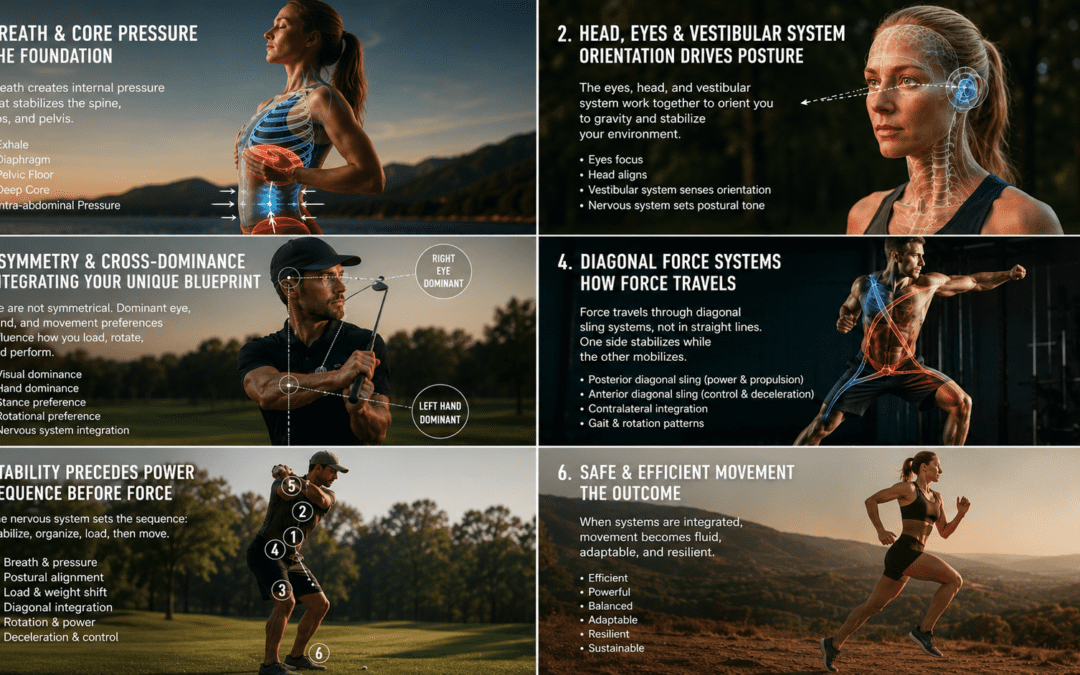
At Fluid Health & Fitness, we often talk about movement not as a collection of muscles, but as a coordinated neurological event.
Efficient movement is not simply about strength, flexibility, or mobility. It is about how the brain and nervous system organize the body against gravity, stabilize pressure, orient the eyes and head, and distribute force through the body in a sequence that minimizes compensation and maximizes adaptability.
This is why two people can perform the same exercise or sport movement and have completely different outcomes:
- one develops efficiency, resilience, and power
- the other develops pain, tension, instability, or chronic overload
The difference is often not effort.
It is organization.
Modern movement science, developmental kinesiology, Dynamic Neuromuscular Stabilization (DNS), gait research, vestibular neuroscience, and fascial integration models all point toward the same principle:
The nervous system prioritizes stability and orientation before force production.
Understanding this hierarchy helps explain what “safe and efficient movement” actually means.
Movement Begins Before Muscles
Most people think movement starts when muscles contract.
Neurologically, movement starts earlier.
Before the body produces force, the nervous system asks several foundational questions:
- Can I orient to gravity?
- Can I stabilize my breathing?
- Can I organize pressure through the trunk?
- Can I stabilize the eyes and head?
- Can I load one side of the body safely?
- Can I transfer force diagonally through the system?
- Then—and only then—can I rotate, accelerate, or generate power efficiently?
This is the foundation of anticipatory postural control.
The body prepares for movement before movement occurs.
Research in stabilization and motor control demonstrates that deep stabilizing systems activate prior to distal limb motion. The nervous system creates a stable reference point before motion is expressed through the extremities.
When this sequence is well organized, movement feels:
- fluid
- powerful
- coordinated
- balanced
- effortless
When it is not, the body compensates through:
- neck tension
- rib flare
- lumbar extension
- poor weight shifting
- excessive gripping
- inefficient rotation
- chronic overuse patterns
Breathing Is a Postural System
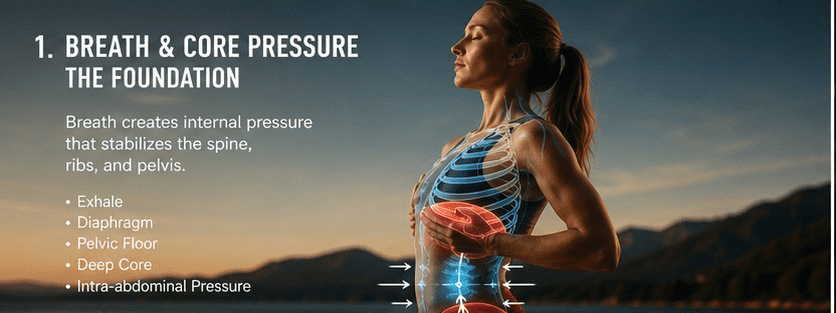
Breathing is not separate from movement.
The diaphragm is both:
- a respiratory muscle
- a stabilizing muscle
DNS emphasizes the integrated role of the diaphragm, abdominal wall, pelvic floor, and spinal stabilizers in maintaining intra-abdominal pressure and joint centration.
Efficient breathing creates:
- spinal support
- rib cage organization
- pelvic control
- nervous system regulation
- force distribution
This is why exhalation is often the first cue in corrective and performance-based movement systems.
A quality exhale helps:
- reduce excessive extension tone
- improve rib positioning
- restore diaphragm function
- improve abdominal integration
- regulate autonomic nervous system activity
Without this pressure system, the body often substitutes stability through:
- excessive neck tension
- lumbar compression
- shoulder gripping
- jaw clenching
The body is always searching for stability somewhere.
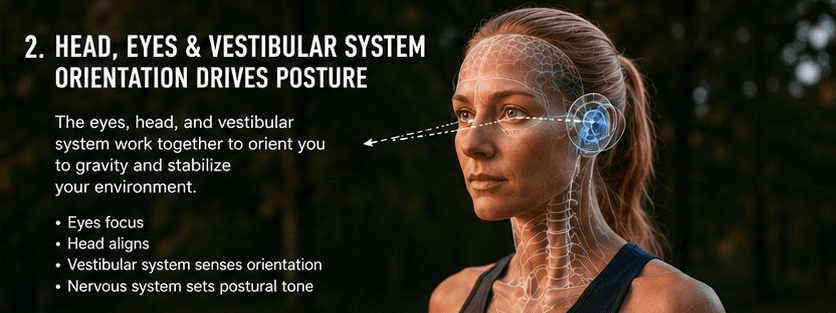
The Eyes, Head, and Vestibular System Drive Posture
One of the most overlooked components of movement is visual and vestibular organization.
The eyes and vestibular system help determine:
- balance
- orientation
- spatial awareness
- postural tone
- rotational strategy
The vestibular system, housed within the inner ear, constantly communicates with:
- the cervical spine
- eye muscles
- postural muscles
- extensor systems
- autonomic nervous system
This is why head position changes posture instantly.
The nervous system uses:
- visual input
- head orientation
- gravity sensing
to determine how the body should stabilize underneath.
In efficient movement:
- the eyes stabilize the environment
- the head organizes orientation
- the trunk organizes pressure
- the limbs express force
When these systems are poorly coordinated, the body often compensates with:
- chronic suboccipital tension
- jaw tightness
- balance issues
- inefficient rotation
- asymmetrical loading patterns
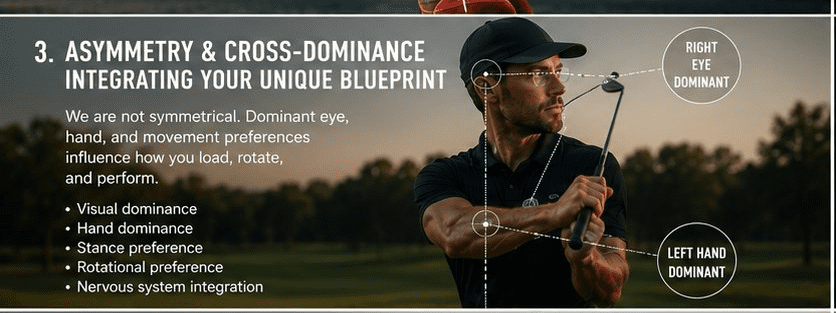
Human Movement Is Naturally Asymmetrical
The human body is not perfectly symmetrical.
We have:
- asymmetrical organs
- asymmetrical diaphragms
- asymmetrical brain specialization
- asymmetrical movement preferences
Research on human lateralization and asymmetry highlights how normal human function is inherently biased and organized asymmetrically.
Most individuals naturally favor:
- one stance leg
- one visual field
- one rotational direction
- one respiratory strategy
This becomes even more complex in individuals who are cross-dominant—for example:
- left-handed but right-eye dominant
- right-handed but left-eye dominant
Cross-dominance can influence:
- head orientation
- stance mechanics
- rotational timing
- visual targeting
- cervical stabilization strategies
This does not mean something is “wrong.”
It simply means the nervous system requires more precise integration between visual orientation and force production.
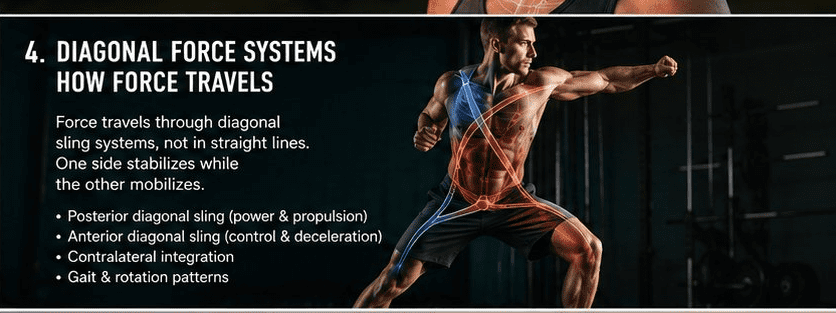
Force Travels Through Diagonal Systems
Human movement is not linear.
Walking, running, throwing, and swinging all rely on diagonal force transfer.
The body organizes force through:
- posterior diagonal sling systems
- anterior diagonal sling systems
- contralateral gait mechanics
This organization begins developmentally during:
- rolling
- crawling
- creeping
- standing
- gait acquisition
Efficient rotational movement is essentially an advanced form of gait.
The nervous system coordinates:
- one side stabilizing
- the opposite side mobilizing
- alternating rotational force
- reciprocal limb movement
This creates:
- elastic energy transfer
- efficient torque production
- balanced deceleration
- reduced stress concentration
When this sequence is poorly coordinated, force “leaks” into areas not designed to absorb it efficiently:
- lumbar spine
- cervical spine
- shoulders
- hips
- knees
The result is often chronic tension and overuse.
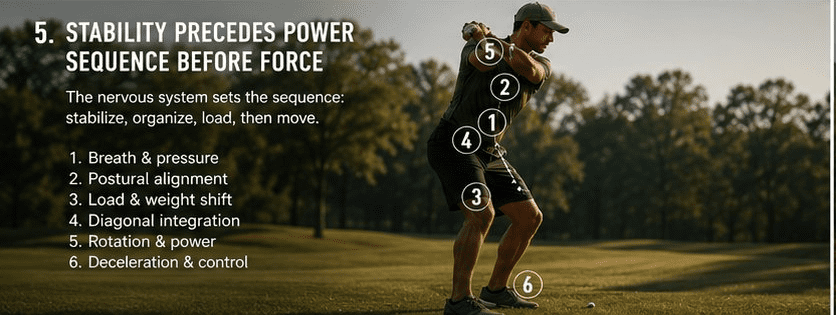
Stability Precedes Power
One of the most important principles in movement science is this:
The nervous system will not produce high-level force through instability it does not trust.
This is why true performance training is not simply:
- lifting heavier
- moving faster
- producing more force
It is about improving:
- timing
- sequencing
- orientation
- pressure management
- contralateral integration
- postural efficiency
At Fluid, our approach emphasizes restoring these foundational systems before layering higher-level performance.
This includes:
- breathing mechanics
- rib cage and pelvic organization
- vestibular and visual integration
- developmental movement sequencing
- gait and rotational mechanics
- integrated strength progressions
The goal is not simply stronger movement.
The goal is movement the nervous system can trust.

What Safe and Efficient Movement Really Means
Safe movement is not rigid movement.
Efficient movement is not “perfect posture.”
Healthy movement is:
- adaptable
- coordinated
- pressure-managed
- neurologically organized
- energy-efficient
It allows the body to:
- absorb force
- transfer force
- rotate efficiently
- stabilize reflexively
- recover quickly
The nervous system is always trying to answer one question:
“Can I safely produce force here?”
When the answer is yes:
- movement becomes fluid
- strength becomes accessible
- mobility improves naturally
- tension decreases
- performance increases
At Fluid Health & Fitness, our mission is to help individuals restore this neurological and biomechanical efficiency from the ground up—through assessment, education, movement retraining, and progressive performance integration.
Because efficient movement is not just about how the body moves.
It is about how the nervous system organizes life against gravity.
Medical & Educational Disclaimer
The information provided in this article is for educational and informational purposes only and is not intended to diagnose, treat, cure, or prevent any disease, injury, or medical condition. Fluid Health and Fitness does not provide medical care, medical diagnosis, or individualized medical treatment through this content.
Human movement, metabolism, and health are highly individual. What works for one person may be inappropriate—or unsafe—for another depending on medical history, current conditions, medications, or risk factors. Before starting any new exercise program, nutrition strategy, breathing practice, or lifestyle intervention discussed here, you should consult with a qualified healthcare provider who understands your personal medical background.
This content is designed to support better understanding of movement, physiology, and performance—not to replace the guidance of a licensed physician, physical therapist, or other medical professional. If you are experiencing pain, symptoms, or health concerns, those deserve real-world evaluation, not internet guesswork (even the good kind).
By reading and using this information, you acknowledge that you are doing so voluntarily and assume full responsibility for how it is applied. Fluid Health and Fitness, its coaches, educators, and partners are not liable for any injuries, losses, or damages that may occur from the use or misuse of this material.
Train smart. Ask good questions. And when in doubt, get real medical eyes on your real human body.