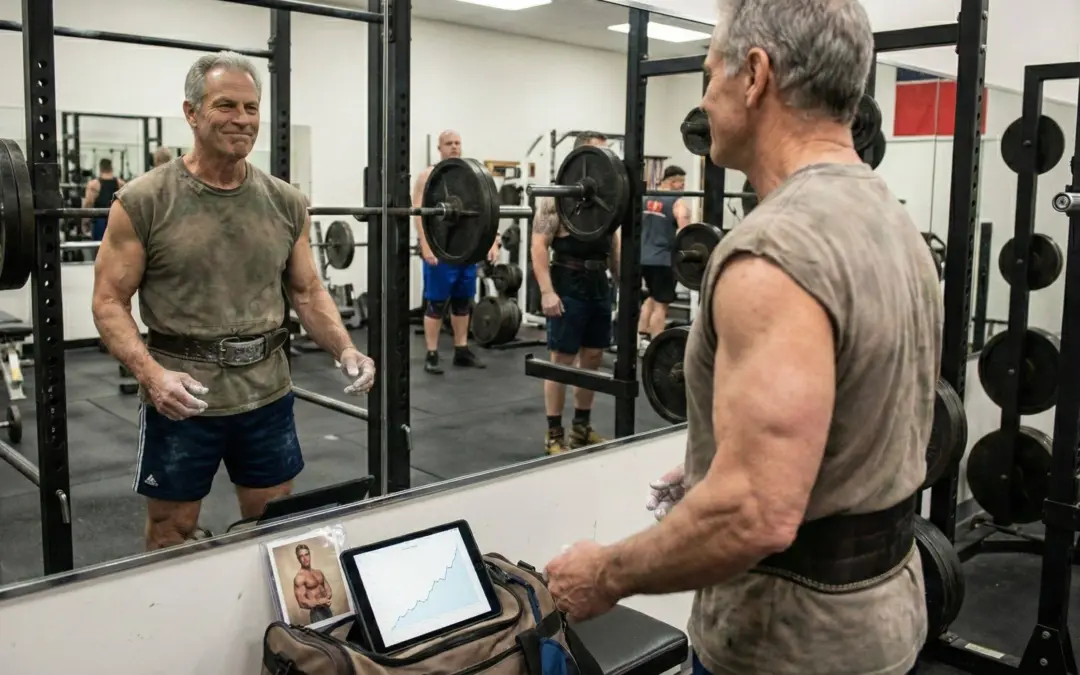
The idea that “you lose everything when you stop training” is one of the most persistent myths in fitness—and it’s wrong. What recent research reinforces is that muscle tissue remembers, even when you stop using it.
The Cellular Advantage: Why Muscle Remembers at the Nuclear Level
Skeletal muscle fibers are unusual cells. Unlike most cells in the body, one muscle fiber contains many nuclei—each responsible for regulating protein production in a specific region of that fiber.
When muscle is exposed to mechanical load (training), it doesn’t just grow thicker. It recruits satellite cells, which are specialized muscle stem cells located between the muscle fiber and its surrounding basal lamina.
Here’s what happens during training:
-
Mechanical tension and metabolic stress activate satellite cells
-
Satellite cells donate additional myonuclei to the muscle fiber
-
Each new nucleus increases the fiber’s capacity to synthesize contractile proteins (actin and myosin)
Think of myonuclei as local managers. More managers = faster production, better quality control, and greater output.
What Happens During Detraining?
This is the critical insight:
-
Muscle size can shrink with inactivity
-
Strength and endurance can decline
-
But the added myonuclei remain
Multiple human and animal studies show that myonuclei are remarkably resistant to apoptosis (cell death). Even during prolonged inactivity, illness, or unloading, these nuclei persist for months or years.
So when training resumes:
-
The infrastructure for growth is already in place
-
Protein synthesis ramps up faster
-
Hypertrophy occurs more efficiently than during first-time training
In practical terms:
You didn’t lose the muscle-building machinery—you just paused it.
This is the biological reason retraining can take ~30% of the original time required to build muscle from scratch.

Epigenetic Priming: The Instruction Manual Is Still Open
Beyond nuclei count, training leaves a second, more subtle imprint: epigenetic memory.
Epigenetics refers to chemical modifications that affect how genes are expressed without changing the DNA sequence itself. These modifications act like bookmarks, highlights, or sticky notes in your genetic instruction manual.
During resistance training:
-
DNA methylation patterns shift
-
Genes involved in muscle growth, metabolism, and repair become more accessible
-
Transcription of anabolic and structural proteins increases
What’s remarkable is what happens next.
Persistence Through Time Off
Research shows that many of these epigenetic changes:
-
Persist during periods of detraining
-
Are not fully reversed even when muscle size decreases
-
Allow faster reactivation of growth-related genes upon retraining
In effect, muscle cells remember how to grow.
This epigenetic priming explains why:
-
Strength returns faster than muscle size
-
Neuromuscular coordination rebounds quickly
-
Even long layoffs don’t reset adaptation to zero
The genome isn’t rewritten—but the volume knobs are already turned up.

Real-World Evidence: Faster Strength Rebound
In controlled studies:
-
Participants completed a training phase
-
Underwent ~10 weeks of detraining
-
Then resumed structured resistance training
Results showed:
-
Lost strength regained in roughly half the original training time
-
Faster hypertrophy compared to first-time training phases
-
Accelerated neuromuscular efficiency and motor unit recruitment
Crucially, these effects weren’t limited to elite athletes. Recreational lifters and casual gym-goers demonstrated the same biological advantage—just scaled to their baseline.
Your cells don’t care about your Instagram following.
They care about mechanical history.
What Muscle Memory Is Not
Let’s keep expectations realistic.
Muscle memory does not mean:
-
You’re injury-proof after time off
-
Tendons, ligaments, and joint cartilage adapt as fast as muscle (they don’t)
-
Conditioning, work capacity, and connective tissue strength rebound at the same rate
Muscle fibers adapt quickly.
Passive tissues lag behind.
That mismatch is where people get hurt.
How to Maximize a Smart Comeback
To leverage muscle memory without paying the injury tax:
Ease in deliberately
-
Start at ~60–70% of prior volume and intensity
-
Allow connective tissue remodeling to catch up
Prioritize movement quality
-
Early retraining is as neurological as it is muscular
-
Clean reps rebuild motor patterns efficiently
Use compound movements
-
Squats, hinges, pushes, pulls, carries
-
They exploit global neuromuscular efficiency and accelerate coordination recovery
Respect recovery
-
Initial DOMS may be exaggerated due to neural re-sensitization
-
That’s normal—don’t confuse soreness with readiness
Sequence before intensity
-
Restore mobility, breathing mechanics, and positional control before loading
-
Strong dysfunction is still dysfunction
Bottom Line
Muscle memory is real, measurable, and biologically durable.
You don’t start over after time off—you restart from a higher baseline, with cellular infrastructure and genetic readiness already in place.
Train intelligently, respect the tissues that adapt slower than muscle, and your comeback will feel less like rebuilding… and more like turning the system back on.